
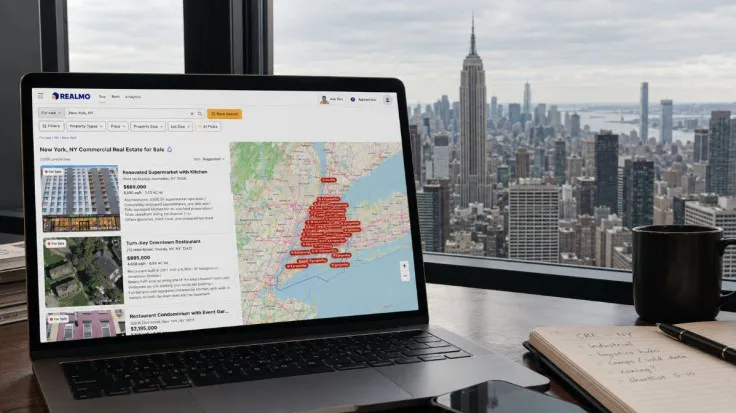
Commercial real estate has embraced AI pilots faster than it has learned to profit from them. That gap is the starting point for a new International Business Times piece on Realmo, and it makes for a clear, well-paced read — even if most of what it reports comes from the company itself.
The article, “Faster Search, Evaluation, and Decision-Making: How Realmo Is Using AI to Rewire Commercial Real Estate”, was written by Sudip Mazumdar and published in the IBTimes Business section on September 30, 2026. It carries a Contributor Content label, so readers should treat it as a company-focused feature rather than independent reporting.
In short: it is a useful primer on the product and on CRE’s data problem, written with more candor than the format usually allows. What it does not offer is an outside view of whether the platform delivers.
A data problem dressed up as an AI problem
The article’s core argument is that AI in commercial real estate stalls less because of the models and more because of the data beneath them. Listings, ownership records, market data and sales history sit on separate platforms, and the dominant paid database, CoStar, averages about $15,000 a year per Vendr’s transaction data.
To frame the stakes, Mazumdar draws on two surveys. JLL found that most investors, owners and occupiers have launched AI pilots, yet only 5% of firms say they have met all their AI goals. A Keyway survey adds that just 8% of professionals consider their data infrastructure fully ready for AI at scale.
Realmo enters as the proposed fix. The New York-based platform, founded in November 2023, reports more than one million active listings across all 50 states and a database of over 50 million commercial properties, including off-market assets. Its bet is that search, analytics and sales records work best in one place.
The centerpiece is Rey, a free conversational assistant that lets users describe what they want in plain language instead of clicking through filters. Around it sit first-pass analysis tools: AI valuations, cap rate-based income modeling, comparable sales and an alternative-use engine. The piece also highlights Recently Sold, launched in August 2025, which opens verified U.S. commercial sales data to all users at no cost.
Where the piece works
The structure is its biggest asset. By opening with the industry’s struggle and the cost of data, the article makes Realmo read as an answer to a specific pain point rather than a product pitch dropped in from nowhere.
It is also refreshingly concrete. Features are named, launch dates are given, and Rey is illustrated with a realistic query — a hunt for undervalued industrial buildings near Midwest logistics hubs. Readers come away knowing what the product actually does.
The benefits are shown through scenarios, not adjectives. A buyer who can see what neighboring properties sold for has leverage against an inflated asking price. A small brokerage gains the kind of transaction data that once favored larger firms.
The developer’s perspective adds credibility. Realmo’s head of analytics explains that Rey separates exact matches from looser alternatives and flags when evidence for a conclusion is thin. That speaks directly to the trust barrier the Keyway survey identified earlier in the piece.
Finally, the article does not hide the platform’s limits. It states plainly that Realmo has published no data on its impact across the full deal timeline and that outdated listings can still surface. That kind of candor is rare in sponsored formats, and it makes the rest of the text easier to trust.
What’s missing
Nearly every figure about Realmo comes from Realmo. The size of the database, the listing count and the “verified” status of sales data go unchecked, and the piece includes no outside expert, customer or analyst.
There are no outcome metrics. Readers never learn how many people use the platform, how much time Rey saves or how accurate its valuations are. The author acknowledges this gap, but a single real-world case study would have strengthened the piece considerably.
The competitive landscape is thin. CoStar appears only as a price benchmark, while other major CRE marketplaces such as LoopNet or Crexi go unmentioned. That leaves readers unsure how Realmo differs in practice.
The business model is left unexplained. If the assistant and the sales data are free, an obvious question is how the platform makes money and whether that approach can last. The article does not say.
The headline promises more than the body delivers. It speaks of rewiring an entire industry, yet the conclusion is more modest: clear time savings exist today only in search and early analysis. Little is said about how the AI itself works or how often the underlying data is refreshed.
There are also small editorial rough edges. The JLL survey and the HackerNoon interview are linked, but the Keyway survey and the Vendr figures on CoStar are not. And the head of analytics is named Iar Arguno in the text, while the interview link spells it ian-arguno — a detail worth checking.
The verdict
Rating: 7 out of 10. The IBTimes piece is a sensible, measured introduction to Realmo and to the data problem holding back AI in commercial real estate. It is not, and does not claim to be, an independent assessment of the platform.
It is most useful for individual investors, tenants and small brokerages for whom paid databases are a real expense, as well as for anyone tracking proptech. Before relying on the platform fully, readers would be wise to test listing freshness and valuation accuracy in a market they already know.
